
What is a Peptide
What Is a Peptide?
Amino Acids, Peptide Bonds & Research Uses
Frequently Asked Questions
Peptides are made from amino acids. Each amino acid has a common basic framework and a side chain that gives it distinct chemical properties. When amino acids connect, they form a sequence. That sequence is central to the identity of the resulting peptide.
Think of amino acids as letters and a peptide sequence as a word. The letters matter, but so does their order. Two chains of the same length can be different molecules if their amino acids or sequence differ. A product’s name and sequence therefore tell you more about its identity than the amount of material alone.
A peptide bond is the covalent link that connects amino acids. More specifically, it joins the carbonyl carbon of one amino acid to the nitrogen of another through an amide linkage. Repeating these links forms the backbone of a peptide chain.
The terms dipeptide and tripeptide describe chains containing two and three amino acids, respectively. For example, KPV refers to the three-amino-acid sequence lysine-proline-valine. The name describes a particular sequence, not a general category of interchangeable products.
Peptides and proteins share amino-acid building blocks. Here is how the terms relate:
| Term | Structure | Key distinction |
| Amino acid | An individual molecular building block. | Separate amino acids can join through peptide bonds. |
| Peptide | A short chain of linked amino acids. | Its amino-acid sequence identifies the peptide. |
| Polypeptide | A chain containing many linked amino acids. | Describes the chain; it may form part or all of a protein. |
| Protein | One or more polypeptide chains folded into a functional structure. | Can catalyse reactions, transport molecules or provide structural support. |
Chain-length conventions overlap; roughly 2–50 amino acids is a useful guide for peptides, not an absolute boundary. A mixture of separate amino acids is not the same as a defined peptide sequence.
Peptides are useful research tools because scientists can study a defined sequence, compare related sequences or investigate how a molecule interacts with a biological target. The appropriate material depends on the question being asked and the experimental method.
Studying molecular interactions
A peptide can help researchers examine how molecules recognise or bind to one another. Experiments may compare different sequences to investigate which features are important to an interaction. The results describe the experimental system and conditions, rather than establishing a universal effect for every peptide.
Developing assays and analytical methods
Synthetic peptides are used in research areas such as assay development, antibody-related studies and mass-spectrometry analysis. Depending on the application, scientists may need a particular sequence, modification, purity or format. Those requirements should be defined before choosing a research material.
Investigating specific biological pathways
Individual products in our range relate to different areas of laboratory research. GHK-Cu is a copper-peptide complex, KPV is a tripeptide, and MOTS-c is a mitochondria-derived peptide. These examples illustrate why peptides should be considered individually: a shared category does not make their structures or research roles identical.
Peptides occur in biological systems, and peptides can also be produced through chemical synthesis. Synthesis allows researchers to obtain defined sequences and, where required, introduce specific modifications. A synthetic peptide may reproduce a naturally occurring sequence or have a different structure designed for a particular research question.
“Natural” and “synthetic” describe aspects of origin or production. Neither term, by itself, establishes a material’s suitability for an experiment. The exact identity, specifications and intended application still need to be considered.
Research peptides are materials supplied for scientific investigation. Their intended application is separate from a medicine, food supplement or cosmetic product. The fact that a molecule appears in scientific literature does not mean that a research product containing it is intended for personal use.
Our peptides are supplied exclusively for in-vitro laboratory research. In-vitro work takes place outside a living organism, such as in an assay or cell-based experimental system. Our products are not for human or animal consumption or administration, and we do not provide personal treatment or dosing advice.
A useful product description should help you identify the material and distinguish it from related products. When reading our catalog, consider the following details together.
- Compound name: Check the complete name, including qualifiers such as “without DAC” in our CJC-1295 without DAC product.
- Quantity and units: Milligrams describe an amount of material, not a solution’s concentration. International units (IU), used for HCG, measure biological activity rather than mass.
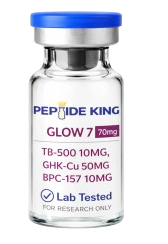
- Blend components: Read each component’s quantity separately. Our CJC-1295 without DAC and Ipamorelin blend contains 5mg of each; a combined total alone does not show the amount of each peptide.
- Type of material: NAD+ is a coenzyme and 5-Amino-1MQ is a small-molecule compound. Bacteriostatic water and syringe kits are laboratory supplies, not peptides.
Lyophilized means freeze-dried. Many research peptides are supplied in this dry form. A lyophilized material and a prepared solution are different formats, and the appropriate handling and storage conditions can change after preparation.
Peptide properties vary, so there is no single preparation method that fits every compound. Follow the product-specific documentation and your laboratory’s validated procedure. Storage requirements should be checked for the exact material rather than copied from a different peptide.
Our catalog brings together individual research peptides, peptide blends, other research compounds and laboratory supplies, with shipping within Canada. You can browse products such as Retatrutide, Tirzepatide, Tesamorelin, GHK-Cu, KPV and MOTS-c, then open each product page for its available quantity and specifications.
If you are new to peptide terminology, start with the compound name and format before comparing amounts or related products. For questions about ordering and delivery, visit our research peptide FAQs. For a product-information enquiry, contact our team with the exact product name and the detail you need clarified.